
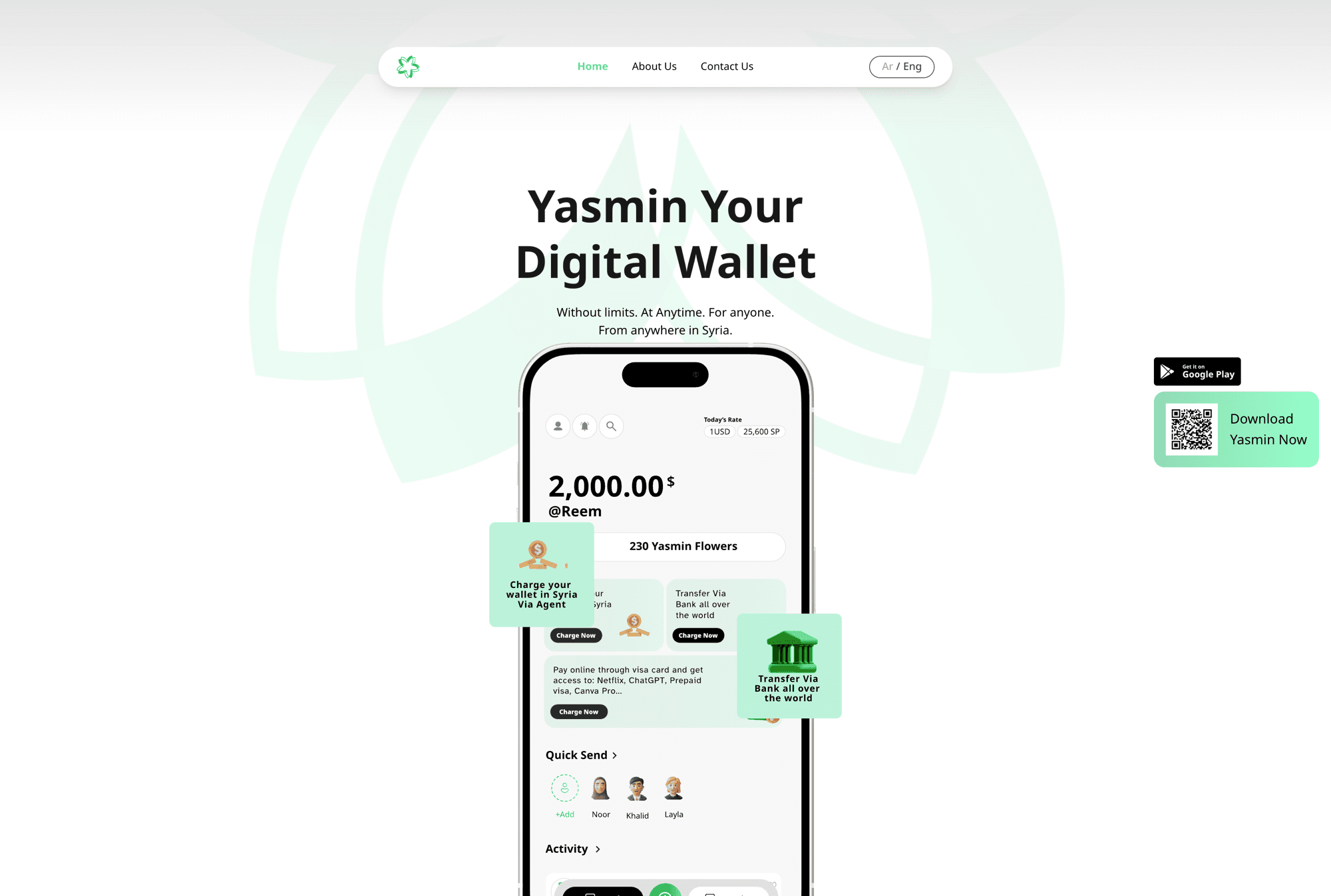
What Yasmin is
Yasmin is a decentralized money transfer app built to connect Syria to the rest of the world. Syria has long been underserved by conventional money transfer options. ShamCash, the existing player, still operates in local Syrian currency, which most Syrians are reluctant to hold or use. Yasmin took a different approach: wallets settled in USDC, the ability to receive transfers directly from a foreign bank account, and the ability to purchase vouchers, a product that didn't exist in the Syrian market at all.
Being decentralized wasn't incidental. It was a core part of the pitch. Funds sat in the user's own wallet rather than a custodial account, so no single party, bank, or authority could freeze or seize their money. In a country where trust in centralized financial institutions is thin, that guarantee mattered as much as the product itself.
My role
I was in charge of the application as a whole: the mobile app, the backend, CI/CD for both, the admin website, and the marketing site. Not one slice of the stack; all of it.
Onboarding and wallets
A user starts by completing KYC. Once approved, a wallet is created for them automatically through Privy (a Stripe company), with no separate setup step. Since this was an MVP, deposits ran through local agents we partnered with on the ground in Syria rather than a fully self-serve on-ramp. Withdrawals gave users a choice: cash out through one of those same local agents, or send funds out directly to a third-party wallet.
Bank transfers, the differentiator
Receiving money from a foreign bank account required a second, separate KYC process, available only to senders outside Syria. Once approved, funds moved from the sender's bank into a Walapay or Bridge wallet, and from there into the recipient's Yasmin wallet. This bank-to-wallet path was the core of what set Yasmin apart from a purely crypto-native transfer app.
Paylinks
Users could also request money directly from other users via paylinks. Opening a paylink into the app used Android App Links and iOS Universal Links, so a shared link opened straight into the app rather than a browser.
Building it
The mobile app was built in Expo React Native. The backend was NestJS, on an architecture the CTO set up. I built CI/CD with GitHub Actions to ship both the app and backend, deploying the app to the App Store and Play Store. I worked closely with our UI/UX designer throughout, across the mobile app, the admin website, and the marketing site, which I also built.
The app supported internationalization and RTL, biometric authentication, and real-time notifications. True to its MVP stage, the backend ran on a VPS with Supabase as the database, rather than a heavier managed setup.
Where it landed
Yasmin reached 1,200 users and seven figures in transfer volume. But shipping took longer than it should have. Business requirements kept shifting mid-build, pulling in feature changes along the way, and in that window, Visa began operating in Syria. We were late to a market that had just opened up. Yasmin was eventually acquired.